
Another Media Literacy Opportunity: How to Help Students Recognize AI in Political Ads
by Frank W Baker (revision)
They (the experts) warned us this would likely happen and their predictions came true. Take a look at these headlines I discovered last Spring:
AI Deepfakes and Manipulated Ads Target Texas Senate Races
AI Video of Ossoff Used by Collins Campaign
AI ‘Deepfake’ Ads Attack Massie and Gallrein in Northern Kentucky GOP Primary
Political Ad Features AI Deepfake of Sherrod Brown
Fully AI-Generated Political AT Ad Takes Aim at Mark Robinson in the NC Governor’s Race
Caveat emptor (Latin for “let the buyer beware”) is an expression that advises we have the responsibility
to check something out before making a purchase, or else we might be fooled or taken advantage of. The same can be said about being aware of the promises candidates might make in their commercials.
I have previously written in this space about what students should know about political commercials. But admittedly much has changed since I provided those recommendations.
We’ve entered another political campaign season where candidates and their advertising firms are
crafting the persuasive messages they hope will sway voters. But this time, there is a new tool in their toolbox:
Generative AI.
“Generative AI (GenAI) is a type of artificial intelligence that creates new content—including text, images, video, audio, and software code—in response to user prompts. Unlike traditional AI, which analyzes existing data, generative AI learns patterns from large datasets to generate original, human-like content, such as that produced by ChatGPT, Midjourney, or DALL-E” (Source)
Political consultant Joe Trippi warns: “A.I. will be used to manipulate and influence voters and citizens to stoke political division and further erode community and our democracy.” (quoted in the New York Times) Pollster Lee Miringoff adds “The potential for AI to spread misinformation is already happening. It’s more than just potential. It’s reality.” (Source: PBS Newshour)
So creators can make a candidate say or do anything using this new technology, and they already have. “AI tools make it possible to quickly and cheaply generate fake articles, images, videos and posts that can look legitimate at first glance.” (Source)
In 2026, as we approach the mid-term elections, one expert warned: “Anytime generative AI is used to create messaging or imagery, that is misleading,” said an advertising executive. (Source)
What if you could alter someone’s voice or even change their appearance in a TV commercial? That technology already exists and it has been used. In 2026, will voters (and students) recognize it or even care?
MEDIA LITERACY MOMENT
I believe THIS is a crucial civics and media literacy moment—all of us need to fine tune our critical thinking skills because someone out there, right now, is creating content to fool us (and it is guaranteed to spread like wildfire on social media.)
National Social Studies teaching standards already provide some guidance here. They focus on developing students critical thinking and media literacy skills to analyze political ads. The standards encourage “students to evaluate the accuracy, bias, and persuasive techniques.” (Source: Socialstudies.org)
The Digital Inquiry Group’s Sam Wineburg is urging schools to teach AI literacy to combat the rise of generated, manipulated content. (Source) Critics worry that educators are not addressing the issue adequately. (See this AI Literacy resource.) With AI-generated content already exploding on social media, will your students be able to differentiate between the real and the fake? (apologies to Mr. Shakespeare –“To be or not to be, THAT is the question”.)
“(AI created) Deepfakes (digitally altered videos) have advanced to the point where even experts cannot easily discern true from false.” (Source) If experts can’t distinguish the real from the fake, what hope is there for our students?
What happens when a candidate uses AI in their commercials? What are the current rules and regulations and who is monitoring all of those thousands of races in 50 states? Advertisers are already on record worrying that tech companies can’t possibly police all of the ads. How can we prepare students for the inevitable time when AI begins to be common in campaigns? Those are some of the questions I sought to answer when writing and researching this article.
Background
Federal law requires political ads to include who paid for the ad and whether it was authorized by the candidate. But for now, there are no federal laws governing AI-generated ads.
Political ads are considered “free speech,” and as such, candidates CAN say anything and broadcasters are
prevented from censoring the ads or refusing to air them. But now that AI-generated ads have become a thing, the rules are slowly changing and becoming increasingly clear.
Major platforms, like Facebook, require labels for AI-altered, election-related content, while state level laws (and proposed federal rules) mandate disclaimers for synthetic audio/video, with penalties for non-compliance.
(Source: Federalregister.gov)
X (formerly Twitter) has also initiated a rule requiring ads on its platforms to be labeled when AI is used.

Source: https://sproutsocial.com/insights/ai-disclaimer/
Many states have passed laws requiring disclosure of so-called “synthetic content.” Some of those states require on-screen graphics such as “this (image/video/audio) has been manipulated or generated by AI” on relevant political ads.
But what if those graphic notifications are so small that viewers won’t see them? That’s exactly what I found in at least two recent examples. First this 2025 political ad criticizing NY Congresswoman Elise Stefanik.
 (screen grab from anti Stephanik ad) |
The disclaimer is in fact so small on screen so briefly that viewers may not even notice it.
|
Second, AI was used in an ad critical of North Carolina gubernatorial candidate Mark Robinson:
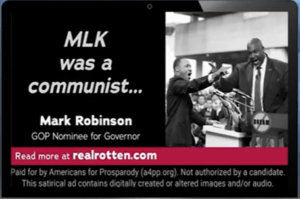 Source: https://youtube.com/watch?v=WXkg1zBUndc Source: https://youtube.com/watch?v=WXkg1zBUndc |
The disclaimer, at the bottom of the screen reads: “This satirical ad contains digitally created or altered images and/or audio” |
“Though helpful from a voter standpoint, (disclaimer) labeling does not deal with the problem of ads conveying fictitious or erroneous information” writes tech expert Darrell West in an op-ed published in the Washington Post.
That is when fact-checking may be the most valuable education resource students should use.
Reliable factcheckers like FactCheck.org, Politifact.com and AP Fact Check (among many others) will be busy reviewing such ads and informing potential voters of what’s true and what’s not.
AI Awareness For Students
Media literacy, using critical thinking/questioning skills, is more important than ever. Digital forensics expert and UC Berkeley Professor of Computer Science Hany Farid urges students to “consider the source.” That’s very good advice. If they’re not sure who created and shared the ad, that might be their first red flag. Unfortunately, many students don’t consider who produced this and why.
What do your students need to know about AI generated campaign commercials? As a media educator, I urge ABS—Always Be Skeptical. If you suspect something is not real, and it may not be—that’s the time to CHECK IT OUT.
What does CHECK IT OUT mean? I am in the habit of using tools like TINEYE.com and GOOGLE’s reverse image search to verify whether a photo is real or fake. What about video? Google LENS may also come in handy here, but some report that it’s not always reliable.
It may not surprise you that there already exists several applications that can be used to verify whether media has been altered. Among them:
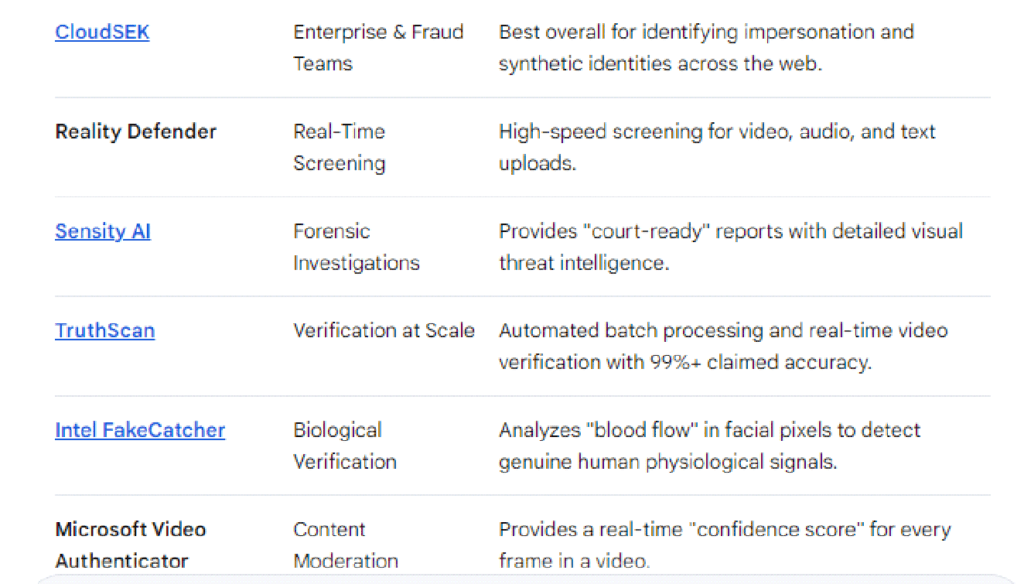
Virus detection company McAfee recommends:
 |
A publicly accessible platform where you can upload media and select different detection models for a probability score. |
 |
Offers a user-friendly online scanner specifically for detecting deepfake videos. |
 |
A browser extension that alerts you in real-time if a video you are watching has AI-generated audio. |
 |
Apps like ForgeSpy on Google Play allow you to run basic AI detection directly from your phone. |
Using A Political Ad Analysis Worksheet With Students
Some years ago, I created the Political Ad Analysis Worksheet—a one page handout designed to help students understand the various techniques used in political commercials. The advice on this resource is still relevant, even in a world where more content is manipulated.
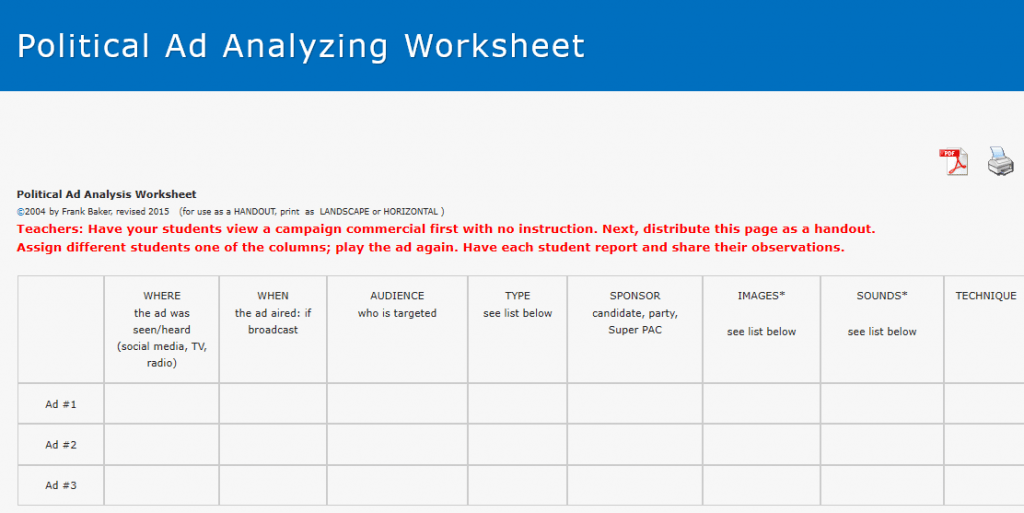
If an ad does utilize AI generated images or video, media watchdogs and factcheckers will most certainly
flag these and report on the specific techniques employed to make it look authentic. What techniques should students watch out for?
Several websites cite these techniques:
–Unnatural features/movement- like perfect skin, strange eye movements, extra fingers
or misaligned earrings or eyeglasses
–Background inconsistencies– text in AI images is often jumbled and objects may look
distorted or unnatural
–Lighting Inconsistency– unnatural shadows
–Audio/Video Mismatches– lips may not be synchronized with the voice, or the sound is
robotic, lacking natural pauses or breaks
– Too Good To Be True—video that appears amateur-looking or Hollywood level quality
(Sources: WRAL and Capitol Technology University)
The Brennan Center for Justice also offers this valuable advice for how to spot and evaluate suspicious content:
– Be skeptical
– Check the source (is it a legitimate candidate or a Super PAC or something else)
– Look for labels (refers to those state or national laws requiring AI ads to be labeled)
-Verify independently (by using reliable fact-check websites)
Conclusion
Several years ago, while working with a large group of social studies educators, I engaged them in
an activity in which they had to write a 30-second campaign ad using a specific candidate and an issue.
All of the teachers agreed that this activity was a real challenge but it demonstrated how those commercials are created and what techniques they use. At the same time, they were challenged to consider
“who’s the audience?” for this ad;
“what techniques were used to attract attention and increase believability?”; and
“where (TV, radio, streaming service) might a candidate air their message in order to reach that demographic”?
As educators you might consider using a known AI-generated commercial in the classroom to engage them starting with the question: “is this real—how do you know”; “how would you go about verifying it” and “what techniques do you recognize as being AI”?
RESOURCE RECOMMENDATIONS
Can you spot a fake political ad? AI is making it harder.
https://www.washingtonpost.com/opinions/2026/04/14/ai-generated-political-ads/
AI Literacy Lessons for Grades 6-12 (Common Sense Media)
https://tinyurl.com/4sx8rnny
AI’s risk to political dialogue and elections
https://www.cleveland.com/opinion/2026/05/ais-risk-to-political-dialogue-and-elections-richard-m-perloff-and-anup-kumar.html
The AI Democracy Dilemma
https://www.journalofdemocracy.org/articles/the-ai-democracy-dilemma/
The AI industry is all in for the 2026 midterms with government regulations looming
https://www.everettpost.com/politics/the-ai-industry-is-all-in-for-the-2026-midterms-with-government-regulations-looming/
The Age of Eerie A.I. Political Ads Is Here
https://www.nytimes.com/2026/03/13/us/politics/ai-ads-campaign-deepfake.html
How to Recognize AI-Generated Videos: Simple Clues to Spot Synthetic Media
https://www.bluesquarealliance.org/command-center-insights/how-to-recognize-ai-generated-videos-simple-clues-to-spot-synthetic-media/
10 Techniques To Spot AI-Generated Videos
https://caniphish.com/blog/how-to-spot-ai-videos
US Law AI Tracker
https://ai-law-center.orrick.com/us-ai-law-tracker-see-all-states/
Generative AI in Political Advertising | Brennan Center for Justice
https://share.google/wGnZPQw61Wa1o8ogP
AI in Political Attack Ads – Watch State Laws on Deep Fakes and Synthetic Media in
Political Content | Broadcast Law Blog https://share.google/6sb2WbeiQ8m4rqHcQ
Beyond the Screen: How the Convergence of Digital, Media, and AI Literacies Sharpens Scientific Thinking
https://www.nsta.org/blog/beyond-screen-how-convergence-digital-media-and-ai-literacies-sharpens-scientific-thinking
What To Know About AI Misinformation: A Primer for Teachers
https://share.google/0nreLUYwmYjkhXIf0
Schools Play Game of Media Literacy Catch Up As AI Use Rises
https://www.edweek.org/technology/schools-play-game-of-media-literacy-catch-up-as-ai-use-rises/2026/04
Deepfake videos degrade political reputations even when viewers realize they are fake
Share This Page: