
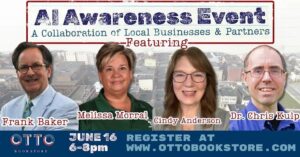
Thank you. Two quotes that I’d like to start with.
FIRST (from an advertising exec)
““Anytime generative AI is used to create messaging or imagery, that is misleading,”
SECOND (from a pollster) “The potential for AI to spread misinformation is already happening. It’s more than just potential. It’s reality.”
This is a crucial/critical time in education and in our lives.
I can’t think of another time when technology has made so much of an impact, so many headlines, both positive and negative.
AI is addictive: that was the headline last week in the Hechinger Report. The writer makes the point: while it races widely ahead in our lives (and in our schools) we had better study it the way we studied drugs and tobacco. Otherwise, who knows?
Have you heard of the phrase: Cognitive surrender? experts now describe what happens when users accept what they find on AI, without any critical thought about its truthfulness…
If there is ONE message I want to leave with you tonight it is this: Experts all agree, VERIFYING what we consume is vital—especially NOW in a world where we can’t possibly discern the real from the fake? But how many of us know how to do that or will bother to take the time to do it?
Since we’re gathered at the Otto Bookstore I have 2 books to recommend…and you may want to write these down: FIRST “VERIFIED: How to Think Straight, Get Duped Less, and Make Better Decisions about What to Believe Online” It’s being called ” an indispensable digital literacy guide.”
SECOND is: The Manipulation Machine: How Media, Algorithms, and Power Shape What We Believe In the Age of Propaganda & Digital Influence
In another article I read last week, the writer said
“The educational challenge is not only ‘spotting misinformation’ but understanding why GenAI output can look plausible even when it is wrong, incomplete, or inconsistent. In practice, he argues that students need support to question GenAI responses, verify claims and recognise when a tool is ‘simulating’ certainty rather than providing actual knowledge.”
A Little History (if you don’t’ mind) AKA how I got here
For many years (more than I care to remember) I’ve been teaching media literacy—but it seems to deaf ears.
For me it started in the late 90s—I worked in Orlando FL for the public school system—at the time the 16th largest in the US.
As an administrator in Instructional TV, I was responsible among other things for purchasing film and video for 150 schools. One week, I sat in many classrooms witnessing how educators used the media.
At the end of the week, writing a report for my supervisor, I was actually appalled and dumbfounded.
-I didn’t witness one teacher employ any pre-viewing, critical thinking questions
– I didn’t hear one teacher introduce vocabulary students might experience while watching
– and finally I didn’t’ see one educator employ any post viewing questions for understanding
I came back to my office, to investigate what at the time were called CRITICAL VIEWING SKILLS—a phrase that I no longer see. Critical viewing skills, I learned, were part of something larger called MEDIA LITERACY—which I define simply as “applying critical thinking to all media messages.”
So a question to the educators in the audience: since you left college, how many of you have had any media literacy training in all of your years in education? (Since I can’t see you I’m going to guess it’s few of you)
So in conclusion-you can’t teach what you haven’t been taught.
Adding insult to injury, real media literacy, as I define it, is difficult to find implemented in public education.
When MOST PEOPLE hear the word LITERACY, they think of PRINT, not media. But media—that dominate our lives– are designed to be read, analyzed, constructed and deconstructed.
It makes a lot of sense to me that teaching MEDIA LITERACY skills should be an integral part of every curriculum’s teacher training plans.
When the Common Core teaching standards were passed 16 years ago, I wrote about what it did not address. Among other things PROPAGANDA was eliminated in the ELA standards of 41 states. (It was replaced by argument.)
Pennsylvania is not a common core state and I was pleased to learn that it IS in the ELA standards: “Students are taught to identify and analyze it as a critical part of media literacy and informational text”
More than anything, media literacy involves critical inquiry—asking questions about the media we all come in contact with. For you educators: Do your students ask questions? (I’ve been encouraging librarians to post the following questions adjacent to every computer and in every classroom)
Questions like: who’s the author; what’s the purpose of the message; what techniques are they using to gain my attention or make it believable; who benefits from the message: and last (but not least) how might people—different from me—interpret this message differently
These are not all of the media literacy questions, but they are a good starting point. (If you want to download a poster with these questions, I recommend you search for the CENTER FOR MEDIA LITERACYs FIVE KEY QUESTIONS).
So these questions are perfect for all media, including AI. but perhaps more importantly, today we must dig deeper because often, we may not know the source of a deepfake. And if the source is unknown, that might be the first best RED FLAG.
So that brings us to AI. It has exploded. It is widely regarded as a “disruptive technology”
And many of you may be wondering: what does it mean for me and what are the implications for here and now?
Here’s just one example
At the present time, I am finishing an article for a national MIDDLE school website about the use of AI in political commercials.
Before I began to research it, I speculated that any AI Disclaimer embedded in a commercial (now required by many states) would be so small , and be on the screen for such a short time, that viewers would likely miss it or ignore. I was right. I have already located several examples.
So as you know, with Generative AI, anybody can make anyone say or do anything. And it has already been used.
Political consultant Joe Trippi predicted that: “A.I. will be used to manipulate and influence voters and citizens to stoke political division and further erode community and our democracy.” (quoted in the New York Times)
I know for example, that the reputable FACT CHECKING
sites—such as FactCheck.org, PolitiFact and Associated Press..among others will be among the first to flag and report on the techniques being used in AI deepfakes.
Will young people care if something is manipulated? Here in SC a teacher told me: my students don’t care if it’s fake news. To which I said: if that sentiment is widespread, we’d better deal with their apathy.
Some young people are already on record worrying about AI’s ability to spread misinformation and disinformation.
(Common Sense, Harvard, Center for Digital Thriving)
Others already recognize Ais limits and say they want formal education on how to use AI, how to fact check, and ethical considerations. (Univ of Illinois study)
According to the Rand corporation: Students’ main worry about AI is that overusing it will erode their critical thinking and problem-solving skills. While many students use chatbots to study or complete assignments, a large majority fear that relying on the technology to do the heavy lifting will make them intellectually dependent and hinder long-term cognitive development.
So what is the solution?
I have questions and perhaps you have the same ones.
Are your schools or district actively providing guidance or training in this new technology? If so great…if not, why not.
I think we must demand it, in order to help students not only be aware but also have the skills to challenge media that’s been altered.
In that article I am writing for MIDDLWEB, I am making note that TODAY there already exists software, applications that can detect when visual media has been manipulated.
Are you aware of that? Educators: would you promote and encourage use of such apps with your students, if you could be assured that they are trustworthy and reliable?
I hope you are all aware of the Civic Online Reasoning Digital Inquiry Group. They have created FREE excellent lesson plans, activities and assessments that everyone should review and consider.
The Digital Inquiry Group’s Sam Wineburg (co-author of “VERIFIED”) is urging schools to teach AI literacy to combat the rise of generated, manipulated content.
So experts recommend that students (and others) get in the habit of VERIFYING what they encounter. What does that involve? My time has run out so I’ll send it back to you all.
Thanks
Q&A
Share This Page:
