
What Every Parent Needs to Know Before Kids Beg “Buy Me That”
Important advice before the holiday toy ad crush
Frank W Baker, media literacy educator & grandparent (revised October 30 2026)
Parents, get ready. Inevitably, your child may soon be begging you, or their grandparents, to “buy me that.” Buy me that: an expression you’ve no doubt heard over the years, after your child has seen something on television (or on the Internet) that they’ve “just gotta have.”
It is this time of year when toy advertisers (LEGO, Mattel, Hasbro and others) are positioning their toy commercials in media they are sure kids will see. Traditionally that meant Saturday morning television, but today, increasingly it’s social media. That means they’re spending more of their ad dollars on YouTube, Facebook, and Instagram digital/influencer campaigns. (Recommended: How Social Media Has Altered Kids Play Purchases and What Is Influencer Marketing and How Does It Target Children? )
To demonstrate the powerful and effective influence of the Internet, analytics company Circana reported recently that, 56% of U.S. parents say their children regularly get their shopping and toy ideas directly from online content and social media creators. (Source)
You may have even heard the expression “kidfluencers”—those are young people paid by a company to use the toy in a convincing and persuasive way in YouTube, TikTok, Instagram or other social media platforms. They create content—such as toy reviews, vlogs, or comedy skits—that often generates views, ad revenue, and brand sponsorships. (Source)
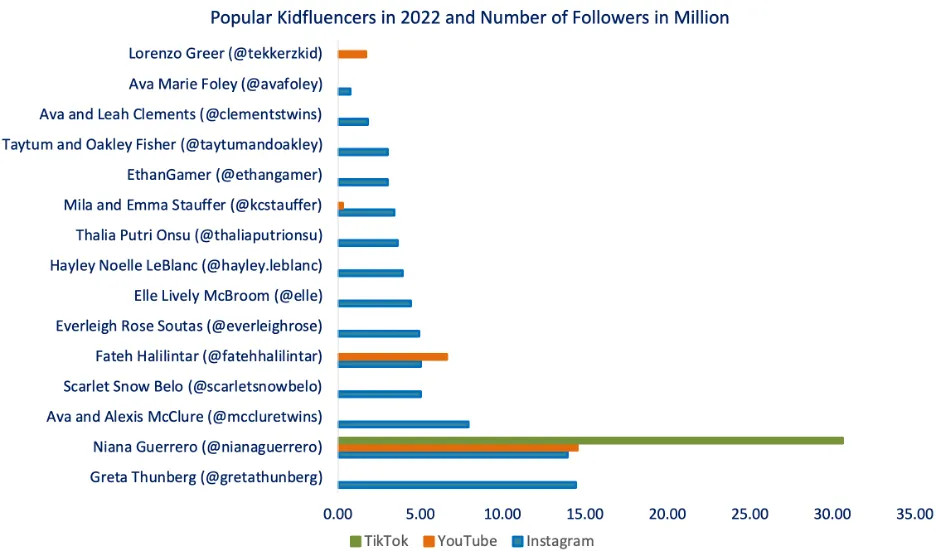
Source: Kidfluencers and what parents need to know about the trend
Good Advice for Parents
Parents should teach their kids how to spot suspicious behavior, understand data privacy, and handle unwanted attention online. Help them develop critical thinking skills so they can recognize marketing tactics and curated content, and make smarter choices when engaging with social media. (Source)
As a media literacy educator, I am writing here with important advice, about how to help your child think more critically. But also advice on how those messages persuade. “Media literacy helps children understand, question and think critically about the messages they see and hear in books, television, videos, games and online.” (Source: Nebraska Public Media)
Do you watch television with your child?
Watching TV with your child is highly recommended, because if left alone, they won’t know what’s real and what’s not, for example. (See The Benefits of Watching TV with Your Child)
Young people should be told that commercials often make things (like toys) appear to be better than they really are (more about that below.)
Several years ago, HBO & Consumer Reports produced a series entitled “Buy Me That- A Kids Survival Guide to TV Advertising.” The series pulled back the curtain on how commercials influence and persuade. In the first episode, young people were given a toy (the Typhoon 2 Hovercraft) to take outside and test. The purpose was to test whether the toy actually performed the way the commercial claimed it does. The children test the gliding toy on all kinds of surfaces and it fails. But the pièce de résistance comes when they try to glide it on water (as the commercial shows) and it fails miserably. One boy sums it up: “the commercial makes it look really good, but it’s just not good.”
In a blogpost I wrote several years ago for Middleweb, I referred to a commercial for “Disney’s Magical Talking Vanity”. When I researched how tall the vanity was, I discovered it was only 20 inches high! (As parents, you probably already know the importance of researching a toy and reading legitimate reviews.) Since I didn’t own the toy, I created a poster which represented how small it really is. I would playback the commercial for the vanity, asking students in my workshop to guess how tall the vanity is. Almost all guessed the vanity was taller than it actually is. Then, I would unfurl the poster –asking a participant to come a kneel down next to the poster–to reveal how “deceptive” the commercial is.
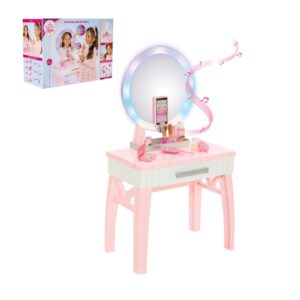
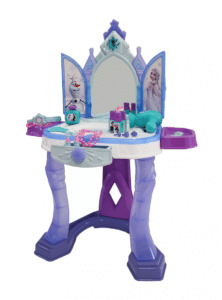
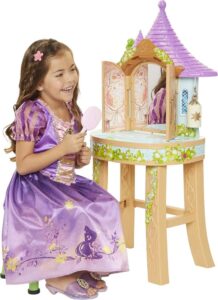
There are now several versions of the girl’s vanity on the market this holiday season:
 |
 |
 |
| Above: Get Ready With Me Glam Vanity
Height: 15 inches |
Above: Disney Frozen Icy Vanity Set
Height: 40 inches |
Above: Disney Tangled Rapunzel Tower Vanity
Height: 20 inches |
The latest version of the vanity (also 20 inches) is the “Disney Princess Ultimate Musical Vanity.” Here is a link to its commercial. And here is a frame grab from the ad:
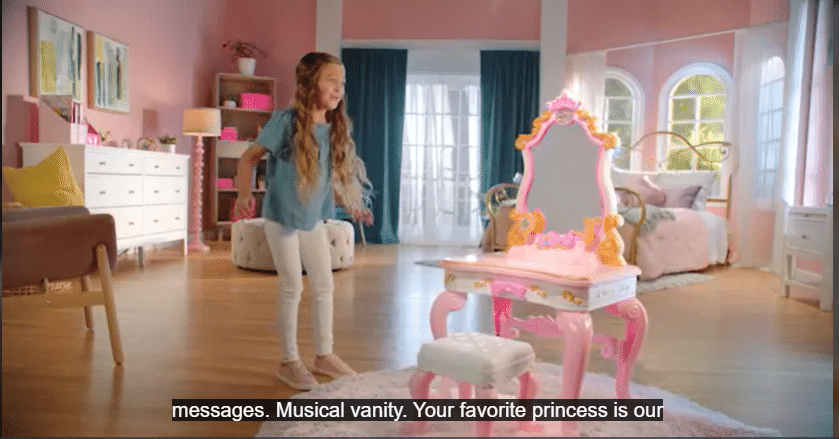
So here is what I noticed: the vanity actually is situated on a platform—making it appear taller than it is–something you (or your child) would not immediately know or think about since the 30 second commercial goes by so quickly. In the commercial, special effects are used to emphasize the music and sounds that emanate from the toy. (Children won’t know that visual effects don’t come with the toy; those are added in commercial production.)
ADVICE: So if you happen to be playing back a commercial that’s been recorded, you can pause it and initiate questions about what they see and believe.
Teaching Your Child to Ask Questions
Media literacy involves asking questions. Helping your child learn to ask questions about the media they come in contact with is a great way to help them think more critically. Starting with the question “what do you see?” is great way to get them to describe what they see, and perhaps what they understand.
One media literacy question in particular seems important here: what technique might the media maker use to make the message (product) attractive?
The technique I am referring to here are “video production” techniques. When young people have experience using a camera, they begin to formulate ideas on what makes a good picture or video. Since many may already have experience watching videos (and ads) on YouTube, they can quickly learn which techniques grab and keep their attention.
Visual literacy skills are important and relevant here.
Small Print, Disclaimers
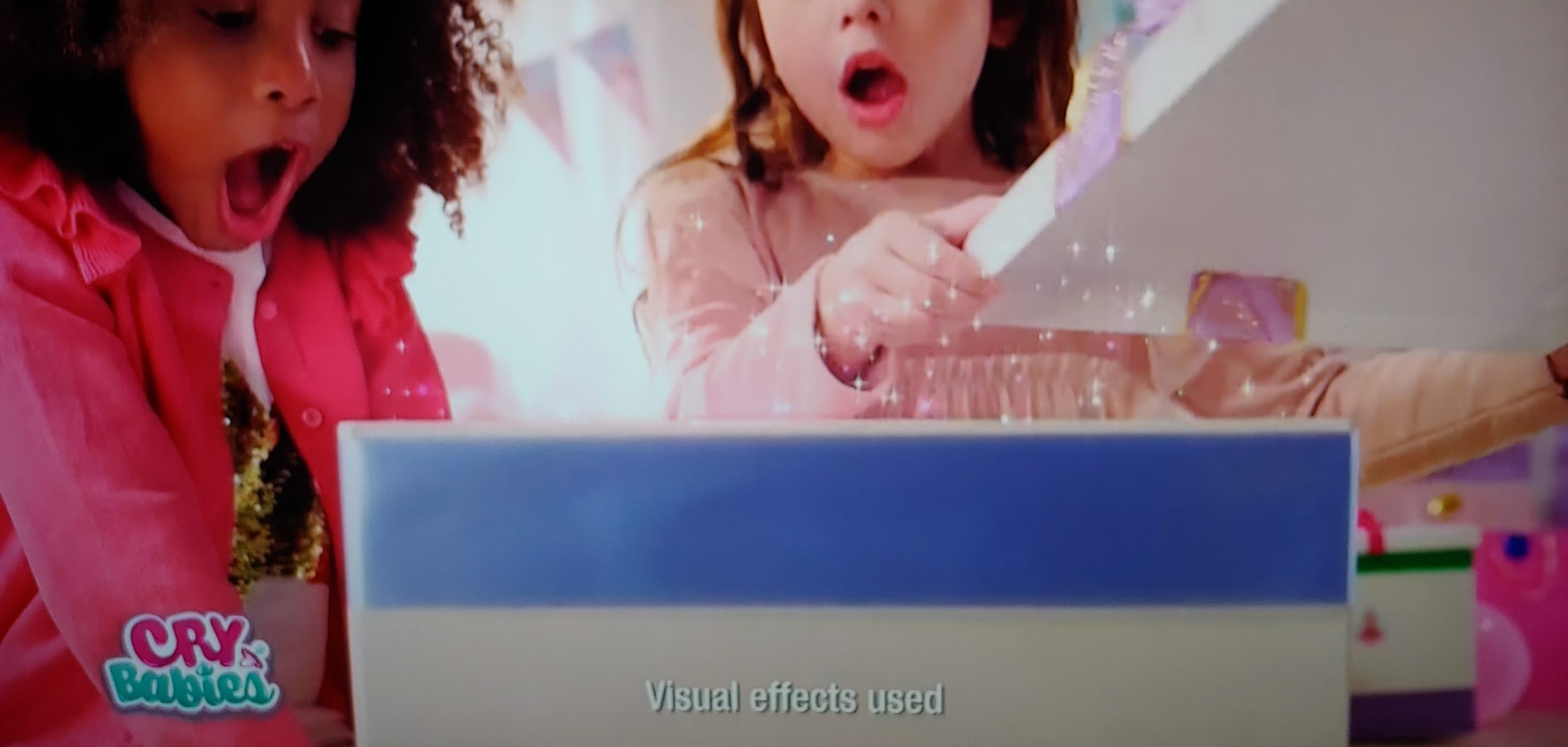
Often, toy commercials include disclaimers, such as “some assembly required, batteries not included.” More recently, special effects are used, again, to make a toy appear to perform in ways it might not in real life. These are important things for parents to know. Those disclaimers are typically at the bottom of the screen and are ‘on screen’ for such a short period of time that you might miss them completely.
Here are two examples:

In conclusion, today all kinds of people online are employing persuasive techniques to get us to believe things—some that aren’t true. By getting in the habit of helping your child ask questions about they consume is an important and vital 21st century skill.
—————————————————————————————————————————————-
Frank Baker, a Columbia native and grandparent, has been teaching media literacy in South Carolina for more than 20 years. His media literacy work was recognized in June 2007 when he received the national Cable’s Leaders in Learning Award (co-presented by the National Cable TV Association / Cable in the Classroom and the National PTA). His life long work was recognized in 2019 when UNESCO honored him with the Global Alliance Partnership For Media & Information Literacy (GAPMIL) award. In 2026, the National Association of Media Literacy Education (NAMLE) awarded him the Elizabeth Thoman Service Award for his contributions. He is the author of several books on media literacy: Coming Distractions (Questioning Movies); Political Campaigns & Political Advertising: A Media Literacy Guide; Media Literacy in the K-12 Classroom; and Close Reading The Media. He is the creator of the Media Literacy Clearinghouse, a resource website for educators, located at www.frankwbaker.com His most recent books include: We Survived The Holocaust (a graphic novel) and Close Encounters With The Great Blue Heron (a photo/science book for kids) He can be reached at fbaker1346@gmail.com
Share This Page:
